Thursday, September 17, 2020

Introduction of Company Accounts | Book Keeping of Company Accounts

INTRODUCTION OF COMPANY

Meaning of Company

A company is a legal entity having an existence separate and distinct from that of its owners. In the eyes of the law, a company is an artificial person having many of the rights and responsibilities of a real person.

A Company, as a separate legal entity, may own property in its own name. Thus, the assets of a company belong to the company itself, not to the shareholders. A Company has legal status in court, that is, it may sue and be sued as if it were a person. As a legal entity, a corporation enters into contracts, is responsible for its own debts, and pays income taxes on its earnings.

A Company can be used to pool the savings of any number of investors, it is an ideal means of obtaining the capital necessary for large scale production. Nearly all large businesses and many small ones are in the form of corporations. "These are in fact, still more single proprietorships and partnerships than joint-stock companies, but in terms of volume of business activity and involvement of funds, companies hold an impressive lead. Because of the dominant role of the companies in our economy, it is important for everyone interested in business, economics, or politics to have an understanding of companies and their accounting practices. 

The growth of large companies has led to a demand for greater information about their profitability and financial affairs from persons outside the corporate enterprise. Virtually everyone buys goods and services produced by our major companies; a large number of people also work for these companies, or receive dividends from them, or sell materials and supplies to them. Thus, the general public and many special interest groups as well are concerned with the operations and financial stability of major companies. Among the specific groups of out-siders demanding accounting information from large companies are existing shareholders, prospective shareholders, creditors, banks. Labour unions, financial analysts, consumer groups, government agencies, and new media of all types.

Advantages of a Company

The company offers a number of advantages not available in other forms of business organizations. Among these advantages are the following:

No Personal Liability for the Shareholders

Creditors of a company have a claim against the assets of the company, not against the personal property of the stockholders. Thus, the amount of money, which the shareholders risk by investing in a company, is limited to the amount of their investment. To many investors, this is the most important advantage of the corporate form.

ii. Ease of Accumulating Capital

The ownership of a company is evidenced by transferable shares of stock. The sale of corporate ownership in units of one or more shares permits both large and small investors to participate in the ownership of the company. Some corporations actually have more than a million individual shareholders. For this reason, large companies are often said to be publicly

Of-course not all companies are large. Many small businesses are organized as companies and are owned by a limited number of shareholders. Such companies are said to be closely held. ii. Ownership Shares are Readily Transferable

Shares of companies may be sold by one investor to another without dissolving of disrupting the business organization. The shares of most large companies may be bought or sold by investors in organized markets, such as a Karachi, Lahore and Islamabad Stock Exchanges, etc. Investments in these shares have the advantage of liquidity, because investors may easily convert their corporate ownership into cash by selling their stock are their market price.

Continuous Existence

A Company is a separate legal entity with perpetual existence. The continuous life of the company despite changes in ownership is made possible by the issuance of transferable shares of stock. By way of contrast.

a partnership is a relatively unstable form of organization, which is dissolved by the death, or retirement of any of its members. The continuity of the corporate entity is essential to most large-scale business activities. Professional Management

Stockholders own the company, but they do not manage it on daily basis. To administer the affairs of the company, the shareholders elect a board of directors. The directors, in turn, hire a president and other corporate officers to manage the business. There is no mutual agency if a company, thus, an individual shareholder has no right to participate in the management of the business unless he or she has been hired as a corporate officer.

Disadvantages of a Company

Among the disadvantages of the company are:

1- Heavy Taxation

The income of a sole proprietorship and partnership are taxable only as personal income to the owners of the business. The income of the company, on the other hand, is subject to income taxes, which must be paid by the company itself. The combination of various taxes often takes a greater part of a company's income. If a company distributes its earnings to shareholders, the shareholders must pay personal income taxes on the amount they receive. This practice of first taxing corporate income to the company and then taxing distributions of that income to the shareholders is commonly called double taxation.

2- Greater Regulation

A Company comes into existence under the terms of laws and the same laws may provide for considerable regulation of the company’s activities. For example, the withdrawal of funds from a company is subject to certain limits set by the law. Pakistan Securities Commission controls the overall operations of companies in Pakistan under Companies Ordinance 1984 and various other regulations issued by the P.S.C.

3-   Separation of Ownership and Control

The separation of the functions of ownership and management may be an advantage in some cases but a disadvantage in some other cases. On the whole, the excellent record of growth and earnings in most large companies indicates that the separation of ownership and control has benefited rather than injured the shareholders. In a few instances, however, a management group has chosen to operate ai company for the benefit of the insiders. The shareholders may find it difficult in such cases to take the concerted action necessary to oust the officers. Thus various, malpractices in operating the affairs of the company are beyond the control of the shareholders.

Departmental Accounts in Branch Accounting | Bookkeeping Guide

 Accounting for Departmental Operations

Departments are usually found in large business concerns. Even

small concerns have departments. Departmental stores in big cities have usually many departments deals in one particular commodity like footwear, baby clothing, household utensils, etc.

 Departmentalization has many advantages, each department works under a departmental manager, and accounting is kept for each department for the purpose of reporting to management, which can evaluate the efficiency and profitability of each department. Further, departmental accounting helps management in planning which is indispensable in every form of organization.


Reports for Departmental Results

As mentioned before, accounting reports for departmental operations for internal use of management for control and planning. are Departmentalization is, therefore, carried to the extent which the management requires. The main purpose is to calculate gross profit and net profit for each department. This pinpoints the expenditure incurred in each department whose head is responsible for such expenditure and its control and successful operations.


Profit by Departments

A- In a merchandising business, the gross profit figure is very important because of the following reasons:

  • ·         Sales and purchases being controlled by a departmental manager is important for control purposes.
  • ·         Management may revise a sale mix to earn maximum profit, decide to change sales or purchase policies, and curtail or expand operations.

  B- However, care should be taken when planning to increase the gross profit of a department, that as a result, operating expenses are not increased dis-proportionately. If operating expenses increase more than the increase in. gross profit, the effect will be a decrease in the net profit.


  C- There are two methods of determining profit and loss department wise. "They are:

  • ·         To departmentalize every-head of account as far as possible and to record every transaction department-wise at the time of its recording.
  • ·         To record transactions without reference to the department and then allocate them to various departments at the time of preparing the profit and loss account.


The second method is less accurate but has the advantage of being less expensive.

Furthermore, there are some items that must be identified with departments, e.g., merchandise inventory, purchases, sales, cash discounts, returns and allowances, and salaries and wages of department employees. Accounting may be maintained easily if columnar journals are maintained, the transactions are recorded therefrom to other books of accounts department-wise. However, there are some items, which it is difficult to identify with the department benefited. Salaries of company officers are examples.


Apportionment of Operating Expenses

A-      Operating expenses are of two kinds:


(i)            those identified with A. department

(ii)           those, which are not. The first one presents no difficulty while others sometimes present difficulty in allocation to the department.

B-      When operating expenses are allocated, they should be apportioned to the respective departments as nearly as possible in accordance with the cost of services rendered to them. If requires the exercise of judgment which varies from person to person, it should be based on sound justification.

C-      Furthermore, the cost of collection and analysis of data should not be excessive. Some of the important items have been dealt with briefly.


Advertising Expenses

The analysis is made to find out the amount of expenditure incurred for each department. The billboard advertising emphasizes the name and the location of the company. It is, therefore, for the company as a whole, and each department benefits from it. The allocation should be on the basis of the amount of the sales of each department. In the case of newspaper advertising, the expenditure should be allocated to each department according to the percentage of space occupied by each department in the advertisements.

·         Depreciation of stores, equipment should be apportioned in proportion to the cost of equipment in each department.

·         Officer's salaries and office salaries may be apportioned on:

1-    Relative time spent of each department; or

2-    The number of sales transactions for each department.

·         Heating and lighting expenses. The basis is:

1-    The floor space, or

2-    According to the number of lights and their voltage. Rent expenses should be apportioned according to the floor area occupied by each department.


  • ·         Property tax expenses and insurance expenses are apportioned on the average cost of inventory of each department.
  • ·         Un-collectible account expenses are apportioned on the basis of the analysis of debts of each department wrote off.
  • ·         Miscellaneous selling expenses and miscellaneous general expenses are apportioned on the basis of sales of each

department.

Chart showing the basis of apportionment of operating expenses

 Head of Account                Basis of Allocation

1-Sales salaries                                     According to the distribution shown

                                                                   in the payroll records        

2. Advertising expenses                        Amount of sales of each department.

 i) Bill-board advertisement                  Percentage of space occupied by each

ii) Newspaper advertisement                department in the advertisement.

 3.Depreciation of stores equipment      On the cost of equipment in each department

 4. Officers' salaries and office             Relative time spent on each department. (OR)

                                                                      The number of sales transactions

                                                                     of each department

 5. Heating and lighting expense          According to the number of lights   

                                                                      or voltage.                                                 

 6-Rent Expenses                                   According to the floor area.

 7- Property tax expenses &                According to the average cost of

   Insurance expenses                            each department      

8. Un-collectible account expenses.          On the basis of bad debts in each department.

 9. Miscellaneous selling expenses and    On the basis of bad debts in each department

miscellaneous general expenses.


Departmental Profit and Loss Account

The following criticism is usually made against departmental profit and loss account:

  • ·         Allocation of income and expense items is done on an arbitrary basis and as such it loses its usefulness.
  • ·         Departments are interlinked and dependent on one another, so the profit of one department is closely related to another.


Department Margin Approach for Income Reporting

In order to overcome these problems, expenses of a department are divided into two categories, as given under:


  • ·         Direct expenses, which are subject in the control of a departmental head, should be included in the departmental profit and loss account; and
  • ·         Indirect expenses, which are not under the control of a department head and have to be allocated arbitrarily, should be excluded.


The advantages of the departmental margin profit and losses account

  • ·     Controlling expenses, thus maximizing profit by using responsibility accounting.
  • ·     Evaluating the profitability and efficiency of a particular department.
  • ·     Rendering aid to management in formulating its policy regarding expansion or discontinuance of an operation or a department


 Discontinuation of A Department

While considering the continuance or discontinuance of the department has to consider the following basic points:

·         How for the indirect expenses will be reduced e.g. other departments will profitably use the space vacated or the space vacated can be given up.

·         As the department is interlinked with other departments, what will be the effect of its discontinuance on the sales of other departments or operations?

·         The redundancy of sales personnel.


If You Like then Subscribe, if You have The suggestion then Describe, If you want to hire for your project then Contact.

Saturday, September 12, 2020

Branch Accounting | Double Entry System | Book Keeping

Accounting for Branch Operations

A- Procedure
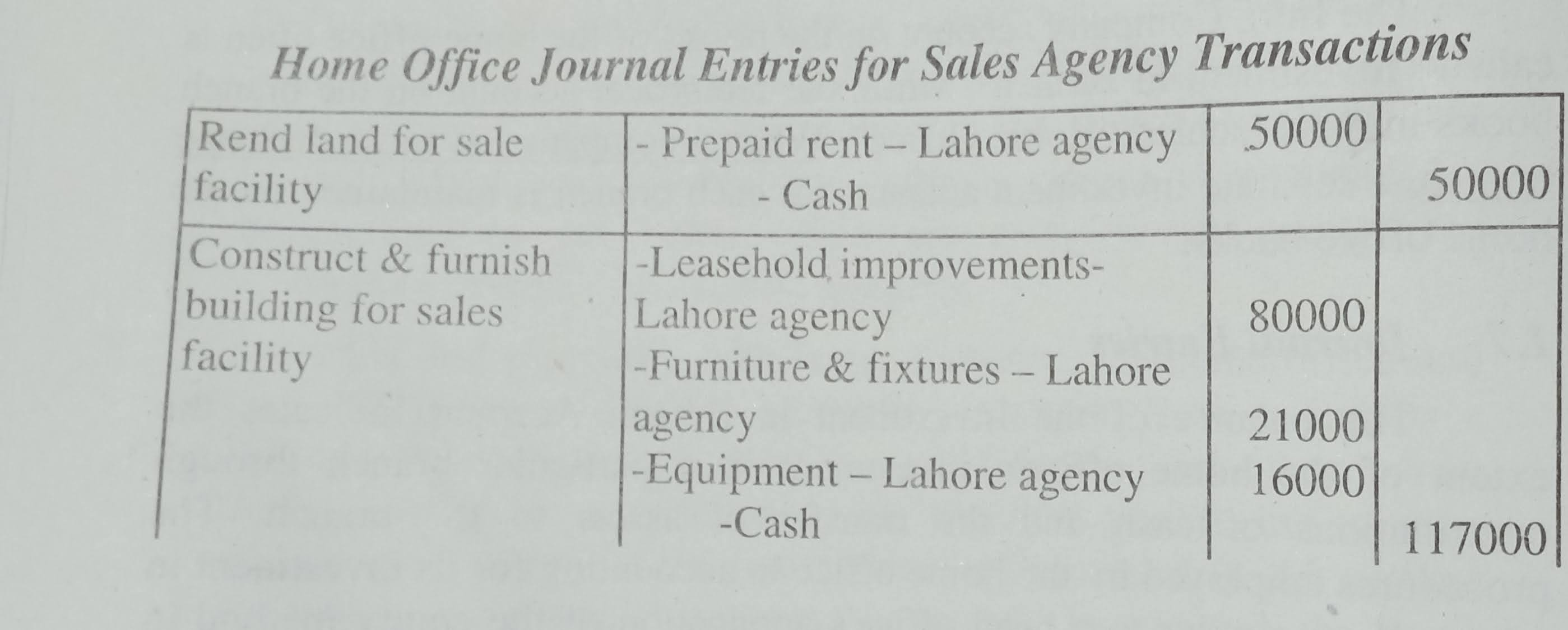
Occasionally, accounting for branch operations is centralized at the home office, and the procedures followed are similar to those for a sales agency. If such an approach is used the branch maintains only limited accounting records and submits source documents for transactions to the home office for entry in the centralized accounting system, just like sale agencies.

Balance Sheet Accounts:

                                     a) Assets

                                      b)Liabilities

                                      c)Owner's Equity


B- Maximum Branches
Normally and especially with larger branches, the home office and branches maintain separate accounting systems. Each maintains a full set of books with a complete self-balancing set of accounts. Each records its transactions with external parties in its own accounting system. These transactions are recorded in the normal manner, and no special treatment is needed. In addition, the home office and branch both must record transactions with one another in their respective accounting systems.
Even though the home office and each branch maintain separate books, all accounts are combined for external reporting in such a way that the external financial statements represent the company as a single economic enterprise. As with the preparation of consolidated financial statements, simply adding together the balances of the accounts contained in each The accounting system does not result in the portrayal of a single economic entity. Certain eliminations are needed as the home office and one or more branches is quite similar to the preparation of consolidated financial statements.

Intra Company Accounts
Transactions with external parties are recorded in the normal manner. Transactions between the home office and a branch also are treated in a normal manner except they are maintaining its record in intracompany accounts. These accounts are reciprocal accounts between the home office and the branch. When the books of both the home office and the branch are completely up to date, the balance in an intracompany account on the home office books will be equal but opposite that of their related intracompany account on the branch books. For example, if an intracompany account on the home office books has an Rs. 10000 debits balance the related Intra Company account on the branch books should have a credit balance of the same amount.
The Intra Company account on the books of the home office often is called "Investment in Branch", while the reciprocal account on the branch books may be labeled "Home Office". When a company has more than one branch, a separate investment account for each branch is maintained on their home office books. 

Income Statement Accounts:

                                                  a)   Operating Revenue

                                                  b) Operating Expenses

                                                  c) Non-Operating Revenues and Expenses

                                                  d) Non-Operating Expenses and Losses    


 Journal Entries


The balance of the Investment in Branch Account indicates the extent of the home office's investment in a particular branch through contributions of cash and the transfer of assets to the branch. The procedures employed by the home office in accounting for its investment in a branch are similar to a head office's application of the equity method in accounting for its investment in a subsidiary. The reciprocal home office account on the books of the branch represent the home offices equity in the branch and the balance is shown in place of owners’ equity in the separate financial statements of the branch prepared for internal reporting purposes.

 The balances of the two reciprocal accounts are adjusted for the same transactions. The account balances are increased for asset transfers from the home office to the branch and reduced for asset transfer from the branch to the home office. Adjustments to the accounts also are made for profits and losses of the branch, with branch profits leading to an increase in the accounts balances and branch losses leading to a decrease. Note that increases in the home office's investment in branch account are accomplished with debit entries and decreases with credit entries. The opposite is true with respect to the branch's Home Office account.
The reciprocal nature of the Investment in Branch and the Home office accounts, and the way in which they are affected by various transactions can be shown as follows:

Entries on Establishment of Branch

When a company establishes a branch, the home office in the investment in branch account records the transfer of assets to the branch. i Similarly, the branch records the transfer with an entry in the account called home office account. To illustrate, assume that the Shah corporation of Islamabad establishes a branch in Mardan. The home office transfers to the branch Rs.20000/- in cash, new office equipment that cost Rs.5000/-. and new store equipment at a cost of Rs. 30000. The Home office records the transfer with the following entry:


Home Office Entries for Branch Accounting:


Double Entry System in Branch Accounts:

Friday, September 11, 2020

Submit a Ticket | Tutor Information | Roll Number Slip | Books Tracking

Submit a Ticket/ Submit A Complain


For Any Type of Complain to AIOU Submit A ticket of Complain Online and Click the Following Link: 

1-                     http://support.aiou.edu.pk/


Tutor Information

you received Tutor Letter/Workshop Schedules by post on your Postal address, if somehow you can’t get any tutor information then, please contact with your concerned regional office and visit AIOU website and find your Tutor from the following link 

2-                      https://si.aiou.edu.pk/

Change of Examination Centre

Change of Examination Centre is not allowed under normal circumstances. However, in hardship cases, change of Examinations Centre is allowed subject to:

(a) In the case where the candidate is a government officers/officer’s spouse/children, production of valid documentary proof transfer letter/posting letter with recent attested, copy of attested National Identity Card, and a certificate from government officer not lower than BPS-18.In the case where the spouse is a government servant, please attached Nikah Nama. 

(b) The candidate or his father changes the place of business or shifts to another station, not more than three months before the final examination, may please be provided.

Download Form from, fill up, follow instructions carefully and send it by post with required documents/fee to the Deputy Controller of Exams

https://drive.google.com/drive/folders/1FpRhz2Iqd5EikrE5YdZLa31SKE-gP77g

 Roll Number Slip Online


If you have not received your Roll Number Slip from Post Office Pakistan then Click the Link Follow and Download your Slip-on time.  


3-                      https://www.aiou.edu.pk/rollnoslips.asp


Admission Confirmation:

If you are facing difficulty in confirmation of your admission or you want to know the history of your admission of different semesters. Then click the following link you will be updated

1-                      https://www.aiou.edu.pk/admission.asp


Books Tracking/ Mailing:

Click the following link if you have not received Your Books or You want to know the delivery status of your books


2-                      http://adms.aiou.edu.pk/mlg/


If You Like then Subscribe, if You have Suggestion then Describe, If you want to hire for your project then Contact.


Monday, September 7, 2020

Important Abbreviation of Daily Life

*_Very Importent abbreviation words* _which we are using in our daily life but we don't know the meaning of these all short words...._ 

(F.A)
Facility of Arts.

(F.SC)
Facility of Science.

(B.A)
Bachelor of Arts.

(M.A)
Master of Arts.

(B.Sc)
Bachelor of Science.

(M.Sc)
Master of Science

(B.Sc.Ag)
Bachelor of Science in
Agriculture

(M.Sc.Ag)
Master of Science in Agriculture

(M.B.A)
Master of Business Administration.

(B.B.A)
Bachelor of Business Administration.

(M.B.B.S)
Bachelor of Medicine and Bachelor of
 Surgery.

(CCNA)
Cesco Certified Network Associat.

(CCNP)
Cesco Certified Network Professional.

(CA)
Chartered Accountant.

(ACCA)
Associat Certified Chartered Accountant.

(CSS)
Center Superior Service.

(I.T)
Information Technology.

(D.I.T)
Diploma of Information Technology.

(M.I.T)
Master of Information Technology.

(M.D)
Doctor of Medicine.

(D.H.M.S)
Diploma of Health and Medical Surgery.

(M.S)
Master of Surgery.

(Ph.D)
Doctor of Philosophy (Arts & Science).

(D. Sc)
Doctor of Science.

(B. Com)
Bachelor of Commerce.

(M. Com)
Master of Commerce.

(Dr)
Doctor.

(B.P)
Blood Pressure.

(Mr)
Mister.

(Mrs)
Mistress.

(M.S)
(used for female married & unmarried)
"Miss" used for unmarried girls).

(M. P)
Member of Parliament.

(M. L. A)
Member of Legislative Assembly.

(M. L. C)
Member of Legislative Council.

(P. M)
Prime Minister.

(C. M)
Chief Minister.

(M.P.A)
Member of Provincial Assembly.

(M.N.A)
Member of National Assembly.

(C-in-C)
Commander-In-Chief.

(L. D. C)
Lower Division Clerk.

(U. D. C)
Upper Division Clerk.

(Lt. Gov)
Lieutenant Governor.

(D. M)
District Magistrate.

(V. I. P)
Very Important Person.

(I. T. O)
Income Tax Officer.

(C. I. D)
Crim Investigation Department.

(C. B. I)
Central Bureau of Investigation.

(G. P. O)
General Post Office.

(H. Q)
Head Quarters.

(E. O. E)
Errors and Omissions Excepted.

(Kg)
Kilogram.

(Kn)
Kilo Newton.

(Kw)
Kilowatts.

(Gm)
Gram.

(Mg)
Milli Gram.

(Km)
Kilometer.

(MM)
Millimeter.

(Ltd)
Limited.

(M. P. H)
Miles Per Hour.

(KM. P. H)
Kilometre Per Hour.

(Am)
Ante Meridiem (or) After Midday.

(Pm)
Past Meridiem (or) Past Midday.

(P. W. D)
Public Works Department.

(C. P. W. D)
Central Public Works Department.

(PM)
Project Manager.

(PD)
Project Director.

(U. S. A)
United States of America.

(U. K)
United Kingdom (England.

(K.S.A)
Kingdom of Saudi Arabia.

(U.A.E)
United Arab Emirates.

(U. N. O)
United Nations Organization.

(W. H. O)
World Health Organization.

(B. B. C)
British Broadcasting Corporation.

(B. C)
Before Christ.

(A. C)
Air Conditioned.

(AC)
Alternative Current.

(DC)
Direct Current.

(S.I)
Sub Inspector (of Police).

(D.P.O)
Divisional Police Officer.

(S.H.O)
Station House Officer.

(I. G)
Inspector General (of Police).

(D. I. G)
Deputy Inspector General (of Police).

(S. S. P)
Senior Superintendent of Police.

(D. S. P)
Deputy Superintendent of Police.

(I.G.P)
Inspector General of Police.

(S.P)
Superintendent of Police.

(I.S.I)
Inter Service of Intelligence.

(S. D. M)
Sub-Divisional Magistrate. 

(S. M)
Station Master.

(A. S. M)
Assistant Station Master.

(V. C)
Voice-Chancellor.

(A. G)
Accountant General.

(C. R)
Confidential Report.

(P.C.S)
Provincial Civil Service.

(M.E.S)
Military Engineering Service

(L.T.V)
Light Tactical Vehicle.

(H.T.V)
Heavy Transport Vehicle.

(EPI)
Electrical pressure injection

(ABS)
Antilock Breaking Sestem.

Full Form Of Some technical Words
VIRUS - Vital Information Resource
Under Seized.

(3G)
3rd Generation.

(4G)
4th Generation

(SMS)
Short Message Service.

(MMS) Multimedia Message Service.

(GSM)
Global System for Mobile
Communication.

(M.A.H)
Milli Ampere Hour.

(CDMA)
Code Divison Multiple
Access.

(UMTS)
Universal MobileTelecommunication
System.

(SIM)
Subscriber Identity Module

(AVI)
Audio Video Interleave

(RTS)
Real Time Streaming

(SIS)
Symbian
OS Installer File

(AMR)
Adaptive Multi-Rate Codec

(JAD)
Java Application Descriptor

(JAR)
Java Archive

(JAD)
Java Application Descriptor

(3GPP)
3rd Generation Partnership Project

(3GP)
3rd Generation Project

(H.D)
High Definition.

(MAA)
Mehboob Anwar Ansari

(MP3)
MPEG player lll

(MP4)
MPEG-4 video file
(AAC)
Advanced Audio Coding

(GIF)
Graphic Interchangeable Format

(JPEG)Joint Photographic Expert Group

(JPEG)
Joint Photographic Expert Group

(BMP)
Bitmap

(SWF)
Shock Wave Flash

(WMV)
Windows Media Video

(WMA)
Windows Media Audio

(WAV)
Waveform Audio

(PNG)
Portable Network Graphics

(DOC)
Document (MicrosoftCorporation

(PDF)
Portable Document Format

(M3G)
Mobile 3D Graphics

(M4A)
MPEG-4 Audio File

(NTH)
Nokia Theme (series 40)

(THM)
Themes (Sony Ericsson

(MMF)
Synthetic Music Mobile Application File

(NRT)
Nokia Ringtone

(XMF)
Extensible Music File

(WBMP)
Wireless Bitmap Image

(DVX)
DivX Video

(HTML)
Hyper Text Markup Language

(WML)
Wireless Markup Language

(CD)
Compact Disk.

(DVD)
Digital Versatile Disk.

(CRT)
Cathode Ray Tube.

(DAT)
Digital Audio Tape.

(DOS)
Disk Operating*_Very Importent abbreviation words* _which we are using in our daily life but we dont know the meaning of these all short words...._ 

(F.A)
Facility of Arts.

(F.SC)
Facility of Science.

(B.A)
Bachelor of Arts.

(M.A)
Master of Arts.

(B.Sc)
Bachelor of Science.

(M.Sc)
Master of Science

(B.Sc.Ag)
Bachelor of Science in
Agriculture

(M.Sc.Ag)
Master of Science in Agriculture

(M.B.A)
Master of Business Administration.

(B.B.A)
Bachelor of Business Administration.

(M.B.B.S)
Bachelor of Medicine and Bachelor of
 Surgery.

(CCNA)
Cesco Certified Network Associat.

(CCNP)
Cesco Certified Network Professional.

(CA)
Chartered Accountant.

(ACCA)
Associat Certified Chartered Accountant.

(CSS)
Center Superior Service.

(I.T)
Information Technology.

(D.I.T)
Diploma of Information Technology.

(M.I.T)
Master of Information Technology.

(M.D)
Doctor of Medicine.

(D.H.M.S)
Diploma of Health and Medical Surgery.

(M.S)
Master of Surgery.

(Ph.D)
Doctor of Philosophy (Arts & Science).

(D. Sc)
Doctor of Science.

(B. Com)
Bachelor of Commerce.

(M. Com)
Master of Commerce.

(Dr)
Doctor.

(B.P)
Blood Pressure.

(Mr)
Mister.

(Mrs)
Mistress.

(M.S)
(used for female married & unmarried)
"Miss" used for unmarried girls).

(M. P)
Member of Parliament.

(M. L. A)
Member of Legislative Assembly.

(M. L. C)
Member of Legislative Council.

(P. M)
Prime Minister.

(C. M)
Chief Minister.

(M.P.A)
Member of Provincial Assembly.

(M.N.A)
Member of National Assembly.

(C-in-C)
Commander-In-Chief.

(L. D. C)
Lower Division Clerk.

(U. D. C)
Upper Division Clerk.

(Lt. Gov)
Lieutenant Governor.

(D. M)
District Magistrate.

(V. I. P)
Very Important Person.

(I. T. O)
Income Tax Officer.

(C. I. D)
Crim Investigation Department.

(C. B. I)
Central Bureau of Investigation.

(G. P. O)
General Post Office.

(H. Q)
Head Quarters.

(E. O. E)
Errors and Omissions Excepted.

(Kg)
Kilogram.

(Kn)
Kilo Newton.

(Kw)
Kilowatts.

(Gm)
Gram.

(Mg)
Milli Gram.

(Km)
Kilometer.

(MM)
Millimeter.

(Ltd)
Limited.

(M. P. H)
Miles Per Hour.

(KM. P. H)
Kilometre Per Hour.

(Am)
Ante Meridiem (or) After Midday.

(Pm)
Past Meridiem (or) Past Midday.

(P. W. D)
Public Works Department.

(C. P. W. D)
Central Public Works Department.

(PM)
Project Manager.

(PD)
Project Director.

(U. S. A)
United States of America.

(U. K)
United Kingdom (England.

(K.S.A)
Kingdom of Saudi Arabia.

(U.A.E)
United Arab Emirates.

(U. N. O)
United Nations Organization.

(W. H. O)
World Health Organization.

(B. B. C)
British Broadcasting Corporation.

(B. C)
Before Christ.

(A. C)
Air Conditioned.

(AC)
Alternative Current.

(DC)
Direct Current.

(S.I)
Sub Inspector (of Police).

(D.P.O)
Divisional Police Officer.

(S.H.O)
Station House Officer.

(I. G)
Inspector General (of Police).

(D. I. G)
Deputy Inspector General (of Police).

(S. S. P)
Senior Superintendent of Police.

(D. S. P)
Deputy Superintendent of Police.

(I.G.P)
Inspector General of Police.

(S.P)
Superintendent of Police.

(I.S.I)
Inter Service of Intelligence.

(S. D. M)
Sub-Divisional Magistrate. 

(S. M)
Station Master.

(A. S. M)
Assistant Station Master.

(V. C)
Voice-Chancellor.

(A. G)
Accountant General.

(C. R)
Confidential Report.

(P.C.S)
Provincial Civil Service.

(M.E.S)
Military Engineering Service

(L.T.V)
Light Tactical Vehicle.

(H.T.V)
Heavy Transport Vehicle.

(EPI)
Electrical pressure injection

(ABS)
Antilock Breaking Sestem.

Full Form Of Some technical Words
VIRUS - Vital Information Resource
Under Seized.

(3G)
3rd Generation.

(4G)
4th Generation

(SMS)
Short Message Service.

(MMS) Multimedia Message Service.

(GSM)
Global System for Mobile
Communication.

(M.A.H)
Milli Ampere Hour.

(CDMA)
Code Divison Multiple
Access.

(UMTS)
Universal MobileTelecommunication
System.

(SIM)
Subscriber Identity Module

(AVI)
Audio Video Interleave

(RTS)
Real Time Streaming

(SIS)
Symbian
OS Installer File

(AMR)
Adaptive Multi-Rate Codec

(JAD)
Java Application Descriptor

(JAR)
Java Archive

(JAD)
Java Application Descriptor

(3GPP)
3rd Generation Partnership Project

(3GP)
3rd Generation Project

(H.D)
High Definition.

(MAA)
Mehboob Anwar Ansari

(MP3)
MPEG player lll

(MP4)
MPEG-4 video file
(AAC)
Advanced Audio Coding

(GIF)
Graphic Interchangeable Format

(JPEG)Joint Photographic Expert Group

(JPEG)
Joint Photographic Expert Group

(BMP)
Bitmap

(SWF)
Shock Wave Flash

(WMV)
Windows Media Video

(WMA)
Windows Media Audio

(WAV)
Waveform Audio

(PNG)
Portable Network Graphics

(DOC)
Document (MicrosoftCorporation

(PDF)
Portable Document Format

(M3G)
Mobile 3D Graphics

(M4A)
MPEG-4 Audio File

(NTH)
Nokia Theme (series 40)

(THM)
Themes (Sony Ericsson

(MMF)
Synthetic Music Mobile Application File

(NRT)
Nokia Ringtone

(XMF)
Extensible Music File

(WBMP)
Wireless Bitmap Image

(DVX)
DivX Video

(HTML)
Hyper Text Markup Language

(WML)
Wireless Markup Language

(CD)
Compact Disk.

(DVD)
Digital Versatile Disk.

(CRT)
Cathode Ray Tube.

(DAT)
Digital Audio Tape.

(DOS)
Disk Operating


If you Like then Subscribe, if You have Suggestion then Describe, If you want to hire for your project then Contact.

Bookkeeping Accounting

Share Capital and Rights of Shareholders

SHARE CAPITAL   Main Sources of Corporate Finance There are four main sources of obtaining or raising funds to finance a company. Sh...